Industry Accredited Courses in Dublin and Beyond: A Professional Guide to Career Advancement 2026
Share This Post
Why does Industry-Accredited Courses and Qualifications Matter More Than Ever in 2026?
Read how the shift towards upskilling is no longer a trend. It’s a necessity.
Are your qualifications preparing you for the workplace of 2027… or the workplace of 2017?
Artificial Intelligence, automation, and digital transformation are reshaping jobs faster than ever before. Yet many professionals across Ireland are discovering that traditional qualifications alone do not always provide the practical skills employers now demand.
The reality is simple: standing still is no longer an option.
This guide explores how industry-accredited courses and qualifications in Procurement, Human Resources, Health & Safety, Logistics, and Supply Chain Management can help you stay relevant, competitive, and future-ready. Discover how CMI Ireland’s flexible programmes enable you to gain workplace-ready skills that can be applied immediately, helping you progress your career in an increasingly AI-driven economy.
Key Takeaways
Understand why industry alignment is the key metric for career advancement in 2026, bridging the gap between theory and functional workplace success.
Evaluate the return on investment offered by professional diplomas compared to traditional academic degrees.
Explore the most relevant industry accredited courses dublin to secure global recognition from prestigious bodies like QQI, CIPS, IOSH, and CIPD.
Leverage practitioner-led instruction and flexible online delivery.
Future-proof your career pathway by aligning your skills with the regulatory standards of your profession in Ireland, the EU and with global governing bodies.
Table of Contents
The Strategic Value of Industry Accredited Courses in the Irish Market
Comparing Professional Diplomas and Academic Degrees: Which Path is Right for You?
Navigating Global Accreditations: From CIPS and IOSH to CIPD and PMI
Advancing Your Career with CMI Ireland: Flexible Learning for Working Professionals
The Strategic Value of Industry Accredited Courses in the Irish Market
Professional accreditation serves as a definitive seal of approval from global bodies like CIPS and IOSH. It signifies that your skills meet rigorous, international standards. In the Irish landscape of 2026, this recognition is becoming more valuable than traditional academic prestige alone. Employers increasingly prioritise “job-ready” certifications because they provide immediate evidence of practical competence. When you hold an accredited qualification, you aren’t just claiming to understand a subject; you’re proving you can apply that knowledge to achieve specific business outcomes.
The shift towards professional learning amongst Irish professionals is no longer a trend; it’s a necessity for survival. As industries transform, the demand for industry accredited courses dublin has never been higher. This evolution reflects a broader move away from generalist education towards specialised, focused and unique learning outcomes to address current market realities.
Bridging the Skills Gap in 2026
Rapid changes in AI, digitalisation and ESG (Environmental, Social, and Governance) have created a significant vacuum in many Irish organisations. Findings from the European Commission suggest that companies must adapt their talent strategies quickly to remain competitive. Sectors such as Logistics and Sustainability are currently experiencing the highest demand for certified practitioners with expert knowledge. One such organisation, CMI Ireland addresses these specific needs by ensuring its curriculum is developed alongside industry practitioners. This alignment ensures you’re learning the exact skills that are currently in short supply, making you an invaluable asset to your employer.
Comparing Professional Diplomas and Academic Degrees: Which Path is Right for You?
Choosing between a multi-year university degree and a professional diploma often comes down to the speed of impact. The return on investment for a professional diploma is achieved much faster in comparison to a four-year degree. For a manager in Dublin, spending four years on a part-time degree might not match the immediate career acceleration offered by a twelve-month specialised Diploma. Employers in 2026 prioritise candidates who can demonstrate functional competence from day one. They value the specific, high-level skills found in industry accredited courses Dublin that are needed to solve immediate operational challenges.
The time commitment is another decisive factor. Academic cycles are rigid, often requiring years of attendance that conflict with a demanding 9-to-5 schedule. In contrast, diploma qualifications are designed for the working reality. They focus on lean, high-impact learning that respects your professional commitments whilst providing the credentials needed for salary growth and promotion.
Technical Depth vs. Broad Theory
Academic degrees usually prioritise generalist theoretical research and modules. Professional diploma courses, dive straight into learning content and practical assessments aligned with current real workplace challenges.
For example, a Procurement diploma student doesn’t study irrelevant economic theory but master’s the CIPS Global Standard to manage complex supply chains. This is essential so that graduates are equipped with contemporary workplace content and assessments that are real to workplace scenarios.
Outdated generalist module content is out and in-comes real-world workplace challenges integrated into every industry focused diploma. This ensures that every hour spent studying translates directly into a solution you can implement at your desk the following morning.
Flexibility for Working Professionals
The transition from on-campus attendance to a live virtual classroom model has revolutionised professional development. You no longer need to navigate Dublin traffic to attend a lecture. Instead, you can engage with industry-expert tutors in real-time from your home or office. This model provides the perfect balance of structured learning and personal flexibility. If you miss a session due to a late work meeting, recorded classes and dedicated tutor support ensure you never fall behind. This supportive environment is specifically tailored for busy leaders who require a steady, methodical path to advancement.
If you’re unsure which qualification aligns best with your current experience and future goals, you can request a professional consultation to explore your options.
Global Mobility and Recognised Standards
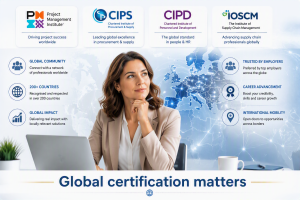
One of the most significant advantages of choosing an industry-aligned path is the “global” status of your credentials. When you earn a diploma recognised by the CIPD Chartered institute of Professional development or aligned with PMI Project Management institute standards, your skills are instantly understood in Ireland, UK, EU, and beyond. This global mobility is essential for working within Ireland’s thriving multinational sector. Whilst local frameworks like QQI and OCNI provide essential quality assurance and domestic recognition, global accreditation ensures your career path isn’t limited by geography. By meeting these international benchmarks, you demonstrate a commitment to the highest levels of professional conduct and technical excellence.
Navigating Global Accreditations: From CIPS and IOSH to CIPD and QQI
Understanding the hierarchy of qualifications is essential for long-term career growth. Whilst many providers offer industry accredited courses dublin, the prestige of the awarding body adds to the weight your CV. Global bodies like CIPS, IOSH. PMI and CIPD set the benchmarks for technical excellence in their profession and set the standards across the world. Holding a diploma qualification from these organisations doesn’t just show you’ve studied a subject; it signals that you belong to an elite tier of globally recognised professionals.
The Irish corporate landscape relies on these “gold standard” accreditations to verify talent. Whether you’re aiming for a senior role in a domestic firm or a multinational, these credentials act as a universal language of competence. They provide a clear framework for progression, ensuring your skills stay aligned with the latest regulatory and industry shifts.
Procurement and Supply Chain Excellence
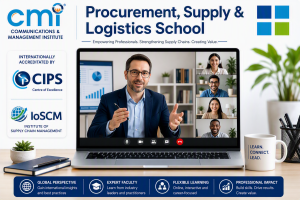
The Procurement, Supply & Logistics School provides pathways to CIPS and IoSCM certifications, which are the industry’s most recognised credentials. These qualifications professionalise the logistics sector by introducing standardised frameworks for risk management and sustainable sourcing. For those working within the Irish public sector, these standards align closely with national procurement guidelines. Mastering these frameworks ensures your workplace skills remain current and compliant.
Health, Safety, and Environmental Management
Moving from a Safety Officer role to becoming a Strategic EHS Leader requires a deep understanding of both domestic and international regulations. The Environmental, Health & Safety School focuses on IOSH-accredited programmes that satisfy the requirements of the Health and Safety Authority (HSA). By mastering these frameworks alongside ISO standards, you ensure your organisation maintains the highest safety benchmarks whilst driving operational excellence in manufacturing and services.
Human Resources and People Management
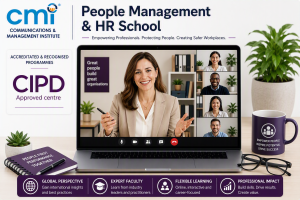
CIPD accreditation is the definitive standard for HR professionals in Ireland, directly influencing salary benchmarks and promotion opportunities. Within the People Management & HR School, the focus extends beyond administrative tasks to core leadership and people management skills. This strategic approach ensures you can lead organisational change and foster a high-performance culture that meets EU standards for workplace development. It transforms HR from a support function into a vital business partner.
Project Management
PMI (Project Management Institute) accreditation is recognised globally as the benchmark qualification for project management professionals and is highly valued by employers across Ireland and internationally. PMI credentials are often associated with enhanced career opportunities, higher earning potential, and progression into senior leadership and programme management roles. They demonstrate that you possess the knowledge, skills, and professional standards required to successfully lead complex projects in today’s dynamic business environment.
The Project Management Schoolis built around the latest PMBOK® (Project Management Body of Knowledge) framework and emerging best practices that are shaping modern project management. Learners gain practical expertise in project planning, scheduling, risk management, stakeholder engagement, budgeting, governance, and agile delivery approaches. This ensures you can confidently apply internationally recognised methodologies to real workplace challenges from day one.
Rather than focusing solely on project administration, the School develops your strategic leadership capabilities needed to deliver organisational change and achieve successful project outcomes. On these industry accredited courses dublin you will gain the confidence to lead cross-functional teams, manage competing priorities, and drive projects to completion. This practical approach helps transform project managers into leaders capable of delivering measurable results.
The Practitioner Advantage
The primary strength of the CMI model lies in its instructors. Learning from someone currently working in the field beats traditional academic lecturing because it prioritises functional application over abstract theory.
See the depth of experience and tutors assigned across each of the Procurement, HR, and Health and Safety Schools. These insights are not available in standard textbooks. You’ll learn how to handle actual workplace scenarios and challenges from professionals who manage them every day. Your tutors who work in their profession during the day will teach you the latest developments in their profession at night.
Advancing Your Career with CMI Ireland: Flexible Learning for Working Professionals
Securing your future in the midst of an AI technological revolution requires a education partner that understands the complexities of the modern workplace. CMI Ireland provides a structured pathway for this transition, offering a range of industry accredited courses from dublin you can utilise to climb the ladder from Level 6 diplomas to postgraduate level qualifications. This progression ensures your learning journey grows alongside your responsibilities. You aren’t just earning a professional qualification; you’re joining a prestigious network of like-minded graduates seeking to influence and change and develop the workplaces of tomorrow.
The flexibility of the CMI model is specifically designed for those balancing a 9-to-5 schedule. By combining weekly live virtual classes with comprehensive online resources, the institute ensures that high-level education remains accessible regardless of your location or time constraints. This approach enables you to progress in your current role while gaining the qualifications needed to increase your earning potential and expand your career.
Securing Your Professional Trajectory for 2026 and Beyond
By choosing industry accredited courses in Dublin, you’ll gain internationally respected certifications from professional bodies such as CIPS, CIPD, and IOSH, enhancing your professional credibility, boosting your earning potential, and opening doors to new career opportunities. These courses act as a catalyst for salary growth and international mobility. By prioritising industry accredited courses from dublin professionals can bridge the gap between theory and workplace success.
Futureproofing Your Career
As highlighted in recent reports from Enterprise Ireland, the next phase of workplace evolution will be defined by AI integration. Continuous professional development (CPD) is the only way to stay relevant as we look toward 2027 and beyond. Completing your first diploma is merely the beginning of a career trajectory that includes ongoing skill updates.
You can meet the CMI Admissions Manager online to explore your course options and to find the right fit between your experience, qualifications and your next step in professional development.
This no-obligation consultation is completely free and is designed to provide personalised guidance, helping you make an informed decision about your next educational investment.
What are the most recognised industry accredited courses in Ireland for 2026?
The most recognised certifications in 2026 include CIPS for procurement, IOSH for health and safety, and CIPD for human resources. These “gold standard” bodies are favoured by multinational and domestic firms alike because they guarantee a specific level of technical expertise. By choosing industry accredited courses dublin professionals can ensure their credentials meet these global benchmarks, providing a clear path to leadership roles in high-demand sectors like logistics and sustainability.
How do I know if a professional course is recognised by Irish employers?
Employer recognition is typically confirmed when a course is aligned with a global governing body or a national regulatory authority like the Health and Safety Authority (HSA). You should check if the qualification is frequently listed as a prerequisite in job descriptions for senior positions in your field. Most Irish employers prioritise practical, workplace-ready skills that have been verified by industry practitioners rather than purely academic assessments.
Can I balance an industry accredited diploma with a full-time job?
Balancing a professional diploma with a 9-to-5 schedule is entirely feasible through modern, flexible delivery models. CMI Ireland’s live virtual classes allow you to attend lectures from home whilst maintaining your professional commitments. Because sessions are recorded and supported by expert tutors, you can manage your studies at a pace that suits your workload without sacrificing the quality of your education or your career performance.
What is the difference between QQI and professional body accreditations like CIPS or IOSH?
QQI frameworks provide national academic quality assurance, whilst professional bodies like CIPS or IOSH offer industry-specific standards and global mobility. Whilst QQI levels help define the depth of study, a professional accreditation functions as a “licence to practice” in a specific sector. Combining both ensures your qualification is respected both academically within Ireland and professionally across the global corporate landscape.
Are online professional courses as valid as in-person evening classes?
Online professional courses are just as valid as traditional evening classes, provided they are led by qualified practitioners and lead to the same accredited qualification. The focus in 2026 has shifted from the physical location of the classroom to the quality of the instruction. Live virtual environments offer the same networking opportunities and real-time interaction as on-campus attendance but with significantly greater convenience for busy managers.
How much does an industry accredited course impact salary growth in Ireland?
Holding an industry-aligned qualification often leads to substantial salary growth by positioning you as a “job-ready” specialist. Employers are willing to pay a premium for professionals who can immediately address skills gaps and navigate complex regulatory environments without extensive on-the-job training. In competitive sectors like Procurement or EHS, an accredited diploma is frequently the deciding factor in securing a promotion or a higher-tier role.
We use cookies on our website to give you the most relevant experience by remembering your preferences and repeat visits. By clicking “Accept All”, you consent to the use of ALL the cookies. However, you may visit "Cookie Settings" to provide a controlled consent.
This website uses cookies to improve your experience while you navigate through the website. Out of these, the cookies that are categorized as necessary are stored on your browser as they are essential for the working of basic functionalities of the website. We also use third-party cookies that help us analyze and understand how you use this website. These cookies will be stored in your browser only with your consent. You also have the option to opt-out of these cookies. But opting out of some of these cookies may affect your browsing experience.
Necessary cookies are absolutely essential for the website to function properly. These cookies ensure basic functionalities and security features of the website, anonymously.
Cookie
Duration
Description
cookielawinfo-checkbox-analytics
11 months
This cookie is set by GDPR Cookie Consent plugin. The cookie is used to store the user consent for the cookies in the category "Analytics".
cookielawinfo-checkbox-functional
11 months
The cookie is set by GDPR cookie consent to record the user consent for the cookies in the category "Functional".
cookielawinfo-checkbox-necessary
11 months
This cookie is set by GDPR Cookie Consent plugin. The cookies is used to store the user consent for the cookies in the category "Necessary".
cookielawinfo-checkbox-others
11 months
This cookie is set by GDPR Cookie Consent plugin. The cookie is used to store the user consent for the cookies in the category "Other.
cookielawinfo-checkbox-performance
11 months
This cookie is set by GDPR Cookie Consent plugin. The cookie is used to store the user consent for the cookies in the category "Performance".
viewed_cookie_policy
11 months
The cookie is set by the GDPR Cookie Consent plugin and is used to store whether or not user has consented to the use of cookies. It does not store any personal data.
Functional cookies help to perform certain functionalities like sharing the content of the website on social media platforms, collect feedbacks, and other third-party features.
Performance cookies are used to understand and analyze the key performance indexes of the website which helps in delivering a better user experience for the visitors.
Analytical cookies are used to understand how visitors interact with the website. These cookies help provide information on metrics the number of visitors, bounce rate, traffic source, etc.
Advertisement cookies are used to provide visitors with relevant ads and marketing campaigns. These cookies track visitors across websites and collect information to provide customized ads.

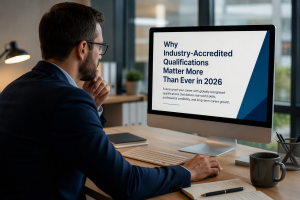
 Professional accreditation serves as a definitive seal of approval from global bodies like CIPS and IOSH. It signifies that your skills meet rigorous, international standards. In the Irish landscape of 2026, this recognition is becoming more valuable than traditional academic prestige alone. Employers increasingly prioritise “job-ready” certifications because they provide immediate evidence of practical competence. When you hold an accredited qualification, you aren’t just claiming to understand a subject; you’re proving you can apply that knowledge to achieve specific business outcomes.
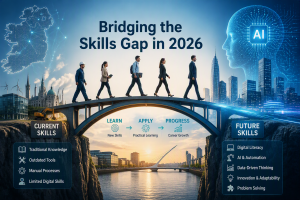 Rapid changes in AI, digitalisation and ESG (Environmental, Social, and Governance) have created a significant vacuum in many Irish organisations. Findings from the European Commission suggest that companies must adapt their talent strategies quickly to remain competitive. Sectors such as Logistics and Sustainability are currently experiencing the highest demand for certified practitioners with expert knowledge. One such organisation,
 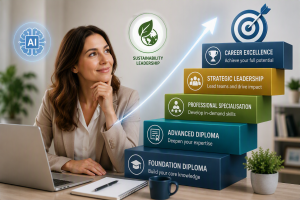 Academic degrees usually prioritise generalist theoretical research and modules. Professional diploma courses, dive straight into learning content and practical assessments aligned with current real workplace challenges.
 The transition from on-campus attendance to a
 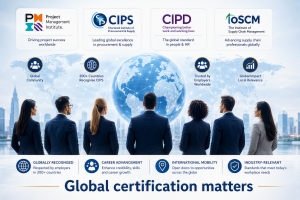 Understanding the hierarchy of qualifications is essential for long-term career growth. Whilst many providers offer industry accredited courses dublin, the prestige of the awarding body adds to the weight your CV. Global bodies like CIPS, IOSH. PMI and CIPD set the benchmarks for technical excellence in their profession and set the standards across the world. Holding a diploma qualification from these organisations doesn’t just show you’ve studied a subject; it signals that you belong to an elite tier of globally recognised professionals.
 The
The 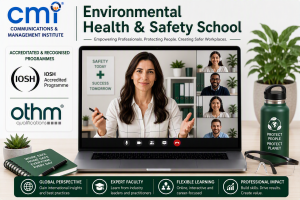 Moving from a Safety Officer role to becoming a Strategic EHS Leader requires a deep understanding of both domestic and international regulations. The
  CIPD accreditation is the definitive standard for HR professionals in Ireland, directly influencing salary benchmarks and promotion opportunities. Within the
 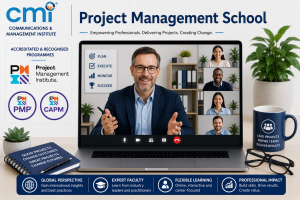 The Project Management School
 Securing your future in the midst of an AI technological revolution requires a education partner that understands the complexities of the modern workplace. CMI Ireland provides a structured pathway for this transition, offering a range of industry accredited courses from dublin you can utilise to climb the ladder from Level 6 diplomas to postgraduate level qualifications. This progression ensures your learning journey grows alongside your responsibilities. You aren’t just earning a professional qualification; you’re joining a prestigious network of like-minded graduates seeking to influence and change and develop the workplaces of tomorrow.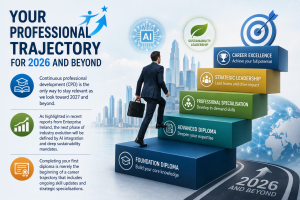
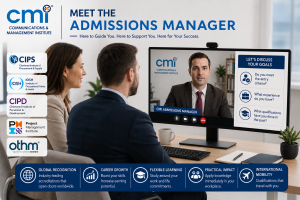 If you’re ready to transform your career path, you should


