Strategies to help you become that perfect Human Resources Manager
Ever curious as to how you can begin a successful career in human resource management?
Getting promoted to management level is a major step of your career and there are a few things to help you become a perfect manager.
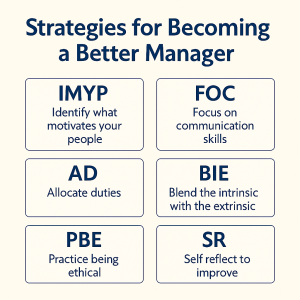
Becoming a better manager involves developing a range of skills and qualities, and we have identified a few below;
Identify What Motivates Your People
Focus On Communicating skills
Allocate Duties
Blending the Intrinsic with the Extrinsic
Practice being Ethical
The best managers, self reflect to improve
Here are some of the ways to become a better manager summarized and then explained:
Identify What Motivates Your People
Every employee is motivated by a different thing. Take time to learn what motivates your people and let them witness your willingness to give and take. This will motivate your team to achieve shared objectives. Your employees should know that you value their wellbeing to motivate them to perform at their best.
Be Flexible
Staying flexible is very important as a manager with your time usually spent doing three distinct things: managing processes, managing people and managing expectations. As work tasks are dynamic and tend to ebb and flow throughout the day and week, it is better to be flexible. Your team members might just surprise you by changing the workflow priorities and finding a more efficient way of doing things that you might never have thought of.
Focus On Communicating skills
A good manager is easy to engage, approach and communicate with. The managers who communicate best are those that build relationships with their team. The more personal, authentic and engaging conversation you can have with employees, the more your employees will want to stay.
A big part of being a better manager is to engage in active listening. Listening to not just what is said, but how it is said. Tone and body language is so important. Even with online meetings it is possible to detect the underlying tone of voice and to determine whether a staff member is anxious or relaxed. Pay attention to what your team members are saying and show that you value their input.
A key aspect of becoming a successful manager is offering clear instructions and ensuring your expectations are clearly understood. Two-Way communication builds robust and trust-based relations. When done in the right way and with the right intentions, feedback can lead to outstanding performance. Employees have to know what they are doing well and not so well, for them to really hear your suggestions on ways to improve.
Effective communication can only happen with self-awareness. Understanding your own emotions and how they affect your behaviour and decisions can make the difference between being a better manager or a poor one. The skill of showing empathy should always be on hand, so that you can recognize the emotions of your team members. Stressful situations can be handled much better when you manage your emotions and think for a moment how you should respond.
Work with your Teams strengths and help them become Problem Solvers
Know what the team’s strengths are and play to them. If you have data-driven people who like to analyse things before making a decision, don’t make rash decisions. Take the time for everyone on the team to get comfortable with the decision.
This also extends to your individual team members. You can increase outcomes, establish strong relations, and help employees to become problem solvers by putting the right members of the team on the right tasks.
Allocation of Duties
Delegation is one of the most important skills a manager can possess and one of the hardest to develop
As a manager open to improve, you need to be calculated about allocating responsibilities to your team. Assigning tasks based on individual team strengths is a very important part of becoming a better manager. You need to trust staff to complete their work and not micromanage. A good manager is not afraid of flexing the management muscle by passing on the responsibilities to the team. They understand the importance of delegation and monitoring the success of what is delegated.
You can motivate staff to propose solutions rather than just bring a problem to you. This will allow them to feel responsible for solving problems on their own. This allows you to increase your own efficiency.
Employee motivation is influenced by various factors that can be categorized into intrinsic and extrinsic motivators. Understanding what these factors are, can help managers create an environment that fosters motivation and enhance productivity.
Intrinsic motivators
Intrinsic motivators are personal and internal and tend to provide satisfaction to each individual staff member in a unique personal way. The work activity itself becomes rewarding in a personal way. A way to becoming a better manager is to learn when to recognise intrinsic motivators. This may be as simple as identifying what work tasks bring enjoyment or a sense of achievement and accomplishment.
Autonomy and Mastery
Being a better manager, is about providing the right environment where staff have autonomy and control over how and when to do their work. This is a big intrinsic motivator. When employees are trusted with responsibilities, it increases their sense of ownership and motivation.
A key sign that a manager is becoming a better manager is when they facilitate skills mastery and opportunities for growth that allows staff to master new skills which in itself drives behaviour.
Access to training, learning resources, and challenging projects can drive motivation by fostering personal and professional growth. A big motivator is for employees to learn how to work better with people and each other. There are a range of CIPD courses that can add significant value and help you become a better manager in the whole area of People Management.
Extrinsic Motivators
Extrinsic motivationis typically any completion of an activity which leads to some kind of reward and tends to be outcome-oriented where the focus is on the end result, rather than the process.
A way to become a better manager is to offer incentive programmes or planned rewards for achieving specific goals or milestones. Competitive pay and performance-based bonuses are strong extrinsic motivators. Any extra benefits such as Health insurance, retirement plans, sponsoring training or qualifications, offering commission or vouchers can enhance personal job satisfaction and act as a reward and motivator.
Better managers know that job security and stable employment is a big extrinsic motivator and reduces anxiety and increases focus and motivation. Loyalty to staff and providing career progression opportunities can motivate employees to perform well.
A safe, clean, and ergonomic work environment can enhance employee well-being and motivation where they look forward to coming to work.
Becoming a better manager, means it doesn’t always have to be a financial motivator but can add value to drive the employee. For example, a big external motivator is giving recognition and appreciation of hard work and achievements to staff which can significantly boost motivation. A key aspect of that is positive feedback. Constructive and positive feedback helps employees feel valued and motivated to perform better. Sometimes learning to become a better manager means enrolling on a well known HR Diploma.
You need to be capable of giving and encouraging feedback to a task done efficiently while guiding those who require improvement in a specific area. Corrective feedback can serve as coaching. When positive criticism is delivered in a careful manner, you can help your team further improve their skills.
Flexibility in work hours and remote work options can help employees balance personal and professional lives, enhancing motivation and providing that extrinsic motivation.
Blending Intrinsic and Extrinsic Motivators
One of the ways to be a better manager is to identify that both types of motivation can be powerful drivers of behaviour. Good management often involves balancing intrinsic and extrinsic motivators to achieve the best results. For example, providing meaningful work and opportunities for personal growth (intrinsic) while also offering competitive salaries and bonuses (extrinsic) can drastically improve both extrinsic and intrinsic motivation.
Concentrate on both results and Data Driven decisions
While outcomes and relations are equally significant, being capable of maintaining healthy relations can allow you to go a long way as a manager. A good manager attends the meetings and discussions not just to focus on accomplishing objectives but to establish healthy relations with the team members.
When you encourage staff to prioritise tasks based on data, you ensure staff are driven by data and analytics to inform their choices.
Staff can dramatically increase the potential success of a project, when they explain logically the data behind work-based tasks. In other words, encouraging SMART objectives are set ensures staff follow Specific, Measurable, Achievable, Relevant, and Time-bound goals. It is essential to provide constructive feedback and monitor progress regularly. A way to be a better manager is to seek input from team members and other stakeholders when making decisions.
Ethical Managers
Showing ethical leadership through adopting ethical work practises, should be encouraged by managers, as it affects reputation at a personal, professional and team level. Ensure that all team members are treated fairly and with respect while maintaining openness in your dealings and decision-making processes.
A way to becoming a better manager is to ensure equality, diversity and inclusion is applied in practice and that environmental, social and governance objectives are met. Managers have a priority to ensure Corporate Social Responsibility is implemented as it benefits society and the environment.
Becoming a better manager means demonstrating honesty and ethical behaviour and showing you abide by a code of ethics. Good managers should ‘shout form the rooftops’ the importance of ethical behaviour and abiding by a code of ethics. Encouraging personal accountability is essential and a great starting place. Start with writing a code of ethics and ask employees for their input in drafting or updating the code.
A key aspect of being a better manager is to support new ideas. Encouraging innovation and creativity is not as easy as it looks. That doesn’t mean you will always agree with new ideas, but creating an environment where team members feel comfortable sharing innovative ideas is the first step. Encouraging experimentation and a ‘learning by doing culture’, ensures your team has the freedom to experiment and learn from failures.
Self-reflect to improve
If you want to become a better manager, take a good, hard look at yourself. The best managers perform regular self-reflection and are aware of their strengths and flaws. They use strengths to their advantage in their management role. They also actively work on their flaws to correct them or, at the very least, keep them from affecting their team. Part of self-reflection is to realise you may need further upskilling and that may mean doing a part time online course in people management .
How do I find out more?
There are a variety of skills to learn as you set out on the journey of becoming a better manager. These steps are covered on CMI’s range of People Management courses which will help you start a successful Career in People Management and Human resources. Find out more today
We use cookies on our website to give you the most relevant experience by remembering your preferences and repeat visits. By clicking “Accept All”, you consent to the use of ALL the cookies. However, you may visit "Cookie Settings" to provide a controlled consent.
This website uses cookies to improve your experience while you navigate through the website. Out of these, the cookies that are categorized as necessary are stored on your browser as they are essential for the working of basic functionalities of the website. We also use third-party cookies that help us analyze and understand how you use this website. These cookies will be stored in your browser only with your consent. You also have the option to opt-out of these cookies. But opting out of some of these cookies may affect your browsing experience.
Necessary cookies are absolutely essential for the website to function properly. These cookies ensure basic functionalities and security features of the website, anonymously.
Cookie
Duration
Description
cookielawinfo-checkbox-analytics
11 months
This cookie is set by GDPR Cookie Consent plugin. The cookie is used to store the user consent for the cookies in the category "Analytics".
cookielawinfo-checkbox-functional
11 months
The cookie is set by GDPR cookie consent to record the user consent for the cookies in the category "Functional".
cookielawinfo-checkbox-necessary
11 months
This cookie is set by GDPR Cookie Consent plugin. The cookies is used to store the user consent for the cookies in the category "Necessary".
cookielawinfo-checkbox-others
11 months
This cookie is set by GDPR Cookie Consent plugin. The cookie is used to store the user consent for the cookies in the category "Other.
cookielawinfo-checkbox-performance
11 months
This cookie is set by GDPR Cookie Consent plugin. The cookie is used to store the user consent for the cookies in the category "Performance".
viewed_cookie_policy
11 months
The cookie is set by the GDPR Cookie Consent plugin and is used to store whether or not user has consented to the use of cookies. It does not store any personal data.
Functional cookies help to perform certain functionalities like sharing the content of the website on social media platforms, collect feedbacks, and other third-party features.
Performance cookies are used to understand and analyze the key performance indexes of the website which helps in delivering a better user experience for the visitors.
Analytical cookies are used to understand how visitors interact with the website. These cookies help provide information on metrics the number of visitors, bounce rate, traffic source, etc.
Advertisement cookies are used to provide visitors with relevant ads and marketing campaigns. These cookies track visitors across websites and collect information to provide customized ads.

 Ever curious as to how you can begin a successful career in human resource management?
 Intrinsic motivators